
By Maisie Jeffreys
In global development and humanitarian work, we are seeing a growing emphasis on two important lenses: systems thinking and decolonisation. Each is powerful in its own right. One invites us to see complexity, the other calls us to confront injustice. But can they work together, or do they pull us in different directions?
I’ve come to see that while they don’t inherently clash, tensions do arise – especially in how they’re applied. The key is not choosing between them, but being intentional about how we integrate both. That means staying grounded in the lived experiences of the communities we serve, while interrogating the power structures that shape the very systems we’re trying to change, and even our concepts of systems themselves.
Is Systems Thinking ‘Westernised’?
An argument can be made that systems thinking is itself ‘Westernised’, with its roots in traditionally Western scientific and philosophical traditions – particularly systems engineering, cybernetics, and general systems theory, which emerged from military-industrial and academic contexts in the Global North. The epistemology of systems thinking often privileges rationality, abstraction, and objectivity, and its visual tools, such as causal loop diagrams and system maps, can unintentionally obscure the social, cultural, and historical contexts in which systems exist.
This can lead to a subtle form of epistemic dominance, where local knowledge systems, oral traditions, indigenous cosmologies, and lived experience are treated as ‘data inputs’ rather than valid ways of knowing in their own right. Even well-meaning systems practitioners can fall into the trap of “mapping”, “intervening” or “labelling” a system from a distance, without interrogating whose system it is, who defines its boundaries, and who has the right to change it. Indeed, indigenous actors often find themselves as recipients of unilateral “classification” exercises by colonial systems.
That’s not to say systems thinking must be discarded when engaging in decolonisation – far from it. But it does itself need to be decolonised. That means drawing on diverse knowledge traditions; using participatory approaches that are rooted in local worldviews; and acknowledging that the act of observing, analysing, and redesigning a system is itself political.
Rather than asking, “How can we improve this system?” we might instead ask, “Whose system is this, and should it exist in its current form?” True systems change requires not only technical insight, but historical consciousness and humility.
By recognising the Western underpinnings of systems thinking, we can begin to unlearn the idea that there is one universal way to understand complexity and open space for plural, relational, and justice-oriented approaches to thrive.
Indigenous Systems Thinking Already Existed
Indigenous world views often hold many similarities to what we know as ‘systems thinking’ today: seeing ourselves as an integral part of the system where all the elements are interconnected, with recognition that actions in one part of the sub-system can have ripple effects in others. Indigenous thinking often emphasies the need for balance, cultural adaptability, and sacredness – arguably going one step further than conventional systems thinking to ensure morality in decision-making.
Arguably a key example of this is the Medicine Wheel (below) – a symbol used my many indigenous cultures for thousands of years to support healing. It represents the interconnectedness of all life and the cycles of existence, often depicted as a circle divided into four sections. Each section symbolises different aspects of life, such as the four directions, seasons, elements, or stages of life.
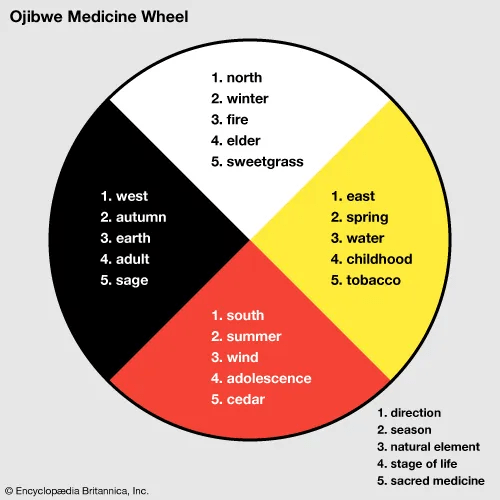
This framework has existed for thousands of years – long before the emergence of Western systems thinking models. The Medicine Wheel, like many Indigenous knowledge systems, embodies a deep understanding of interdependence, cycles, and balance. It reflects a worldview where relationality, reciprocity, and spiritual responsibility are central – not abstract theories but lived, practiced truths. Recognising this challenges the assumption that systems thinking is a modern or Western innovation, and reminds us that many communities have long held rich, holistic approaches to complexity and change. The task now is not to “introduce” systems thinking to these contexts, but to honour and learn from the systems thinking that already exists.
Can they Coexist?
Yes – but only when we acknowledge the tension and hold these approaches in creative dialogue.
Decolonisation without systems thinking risks being reactive or overly focused on identity and narrative, without fully understanding how entrenched systems reproduce harm at scale. Meanwhile, systems thinking without decolonisation can be blind to structural injustice, reinforcing the same top-down, expert-led paradigms that marginalised voices have long challenged.
What’s needed is systems thinking that is decolonised – that actively questions its own assumptions, draws from local systems of knowledge, and is designed with, not just for, communities.
This means:
- Co-creating systems thinking approaches with local actors, not consultants flown in for a week
- Reframing what counts as knowledge, recognising oral history, experience, and traditional practices as valid and valuable
- Designing programmes that redistribute power, not just redesign workflows
- Understanding that “leverage points” (the areas in the system where a small intervention could make a large difference) are often social, cultural, or relational – not just policy or finance
This is not just a question of methodologies – it’s a question of values and accountability.
If systems thinking is to help us build better futures, it must confront the legacies of the systems we’re in – including colonialism, racial capitalism, and epistemic injustice. And if decolonisation is to drive enduring change, it must engage with the structural and dynamic nature of the problems we’re facing.
Together, they can help us move beyond fragmented interventions toward transformative, community-led solutions that honour both complexity and justice.
 A Systems Lens