
By Maisie Jeffreys
Want support creating sustainable systemic change? Get in touch to explore our consultancy services at maisiejeffreysconsultancy@gmail.com
We recommend reading our blog on ‘Understanding Systems Thinking in Practice’ before diving into this one!
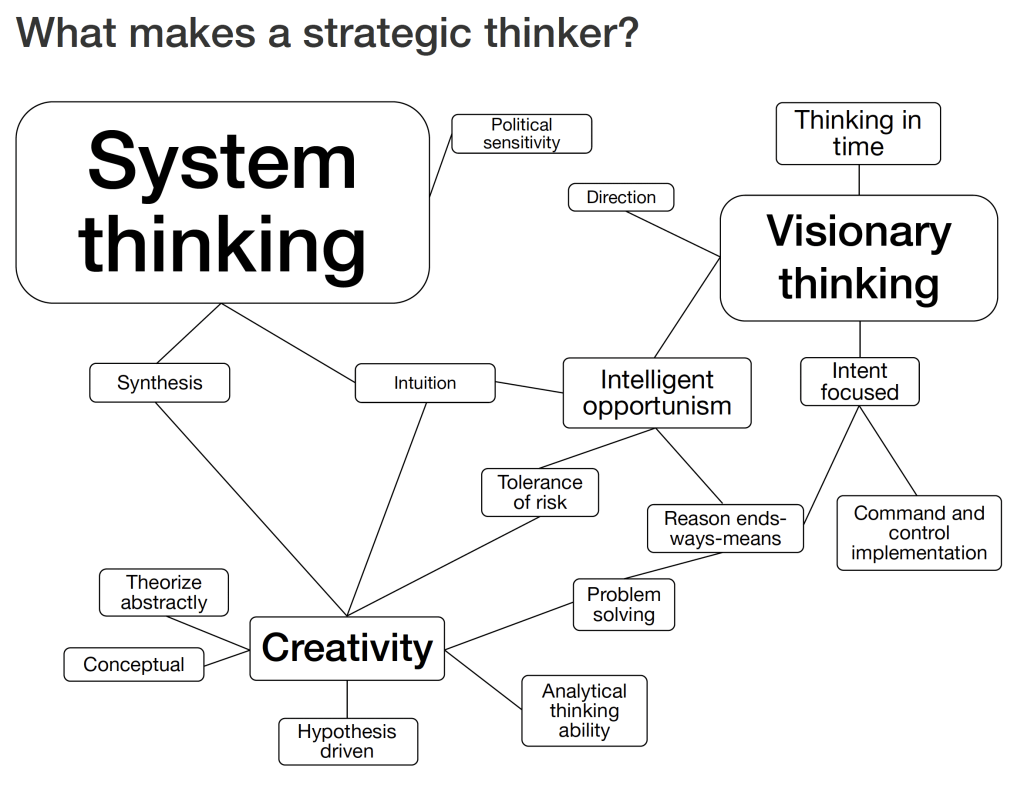
In strategy work, we often focus on goals, plans, and performance – how we move from point A to point B. That’s the core of strategic thinking: aligning resources and efforts to achieve specific objectives. But in complex, messy, real-world problems, – where power, culture, and systems of inequality collide – strategic thinking alone isn’t enough.
This is where systems thinking becomes essential.
While strategic thinking helps us make choices and set direction, systems thinking helps us understand the environment we’re operating in – the relationships, root causes, and underlying structures that drive outcomes. It reminds us that not all problems are solvable through linear planning or top-down control.
Together, they’re powerful:
- Systems thinking helps us see the bigger picture
- Strategic thinking helps us act intentionally within it
A strategy for systems change integrates both, whereby systems thinking informs strategic thinking. It’s not just about setting goals – it’s about shifting the deeper dynamics that keep problems in place.

‘We tend to use strategy as a general term for a plan, a concept, a course of action, or a “vision”…Such casual use of the term to describe nothing more than “what we would like to do next” is inappropriate and belies the complexity of true strategy and strategic thinking’. (Prof Douglas Lovelace Jr., Director of the US Strategic Studies Institute)
So how do we do that in practice?
How to Build a Strategy for Systems Change
If you’ve ever asked yourself “How do we make our work more transformative?” or “What would it take to actually change the system, not just patch it?” – this guide is for you.
Here’s a step-by-step process that I’ve used with locally-led Hubs, grassroots organisations, and cross-sector partnerships around the world:
🔍 Step 1: Understand the System You’re Working In
A key first step in systems thinking is defining the boundaries of the problem – deciding what to include and exclude in your analysis. Because no system is ever truly closed, this requires considering the wider context and potential ripple effects of any decision. Once boundaries are set, a systems thinker looks at how components interact, how processes are interrelated, and how systems connect and evolve over time.
Ask:
- Who are the actors in the system and how do they interact?
- What are the visible and invisible forces sustaining the problem?
- What rules, norms, or relationships keep things the way they are?
- Who holds power and who is excluded? Where do the resources exist?
- What change do we want to see in the system? What is the future we are aiming to create?
🎯 Step 2: Identify Leverage Points for Change
Not all actions are equal. Some small shifts can unlock big change.
Look for:
- Deep leverage points (e.g. shifting mental models or decision-making structures)
- Quick wins that signal change and build momentum
- Reinforcing feedback loops – both helpful and harmful
Sometimes the most powerful change isn’t a new programme – it’s a new question, asked in the right space
🛠 Step 3: Design Initiatives That Shift Underlying Conditions
Now, design strategically – but with systems in mind.
Your strategy should:
- Work across different levels: individual, institutional, and systemic
- Centre those most impacted by the system
- Aim to shift patterns – not just plug gaps
Think prototypes, not perfect plans. Systems are dynamic—your strategy should be, too. It should be able to experiment and adapt.
🔄 Step 4: Embed Feedback Loops and Learn as You Go
In complex systems, you can’t predict everything. But you can learn fast.
Build in:
- Regular reflection cycles
- Space to listen to frontline feedback
- Mechanisms to adapt based on what’s emerging
In systems change, learning is your strongest strategy.
🌱 Step 5: Align, Scale and Sustain
Long-term change requires collective energy.
- Align your work with others moving in the same direction.
- Don’t scale by replicating – scale by seeding ideas, shifting mindsets, building cultures and networks
- Embed the work into governance, leadership, and narrative.
Systems change isn’t something you do alone. It grows through coalition, coordination, and care.
See our resources section for practical tools that can guide you through these stages!
How do I know if my strategy has the potential for systems change?
When analysing if your initiative, strategy or organisation has the potential for systems change, it’s important to ask the right questions. See here for our cheat sheet on how to analyse this!
Conclusion
A strategy for systems change doesn’t promise neat outcomes or perfect plans. It requires humility, curiosity, and a willingness to sit with complexity.
But it’s also how we move from short-term wins to lasting transformation. From isolated interventions to reimagined systems. And from control to collaboration.
If we want to build a more just, inclusive, and sustainable future, we need more than goals – we need strategy that sees the system, shifts the rules, and shares the power.
 A Systems Lens