
By Maisie Jeffreys
If you’re like me, and you own a face and are female you’ve likely been told at some point you’ve had ‘resting bitch face (RBF)’.
RBF is a modern term used to describe (usually a woman) who doesn’t hold a smile at rest – they may appear to look angry or serious even when calm and content inside.
First popularized in a 2013 viral video as a joke and picked up with speed on social media and online (the New York Times even wrote a trend piece called “I’m Not Mad. That’s Just My RBF” in 2015), it eventually made its way into our general lexicon.

Source: https://www.ndtv.com/offbeat/scientists-have-discovered-what-causes-resting-bitch-face-1273141
And that, for me, is where I see the problem: the term’s popularity is a visible symptom of a much larger, sometimes hidden system of sexism and oppression.
A Brief History of ‘Not Being a B*tch’
(I’m going to try to summarise, but I mention much more qualified people who talk about this in greater detail below).
Across cultures, femininity has been framed as obedience, politeness, and attractiveness toward men, while masculinity is associated with boldness, authority, and speaking one’s mind. These traits are not just permitted in men – they are actively rewarded and desired. A “man’s man” is aspirational. The same behaviours in women, however, are often read as abrasive, unlikeable, or unattractive. Such expectations damage all genders.
I’ve heard time and time again that these kinds of male-female roles are ‘natural’ (at which point someone will cite early cave people and hunter-gatherer relationships). However, many academics and historians argue that patriarchalism is something that has been intentionally architectured and reinforced – with a history pre-dating capitalism, it became deeply entrenched within our society and systems over thousands of years.
In early hunter-gatherer societies, gendered divisions of labour were indeed common, but varied widely, and are generally considered to have been more equal (or equally-valued). This division is not in itself an unequal or oppressive arrangement, but the issue arises when this division became a relationship of dominance and oppression.
Arguably, the development of agriculture, private property, and the plough played a key role in entrenching women’s subordination. In Patriarchy and Accumulation on a World Scale, Maria Mies advances the hypothesis that the rise of male-dominated livestock breeding reduced the social value of women-dominated gathering roles.
Combined with men’s role as hunters – which fostered expertise in weapons, aggression, and capture – this shift coincided with increasing pressure on women to bear and raise children, and to be controlled alongside the animals themselves. While evidence suggests that women were often the first agriculturalists in early societies, their reproductive labour increasingly bound them to continuous, time-intensive, and undervalued work.
Men, by contrast, were freed from the hour-to-hour demands of pregnancy, childbirth, and childcare, a freedom made possible by women’s labour. This allowed men to engage in hunting, raiding, and the capture of women and young men from neighbouring agricultural and nomadic groups. Through pillage and force, early forms of surplus, private property, and power were accumulated. Notably, this accumulating class was almost entirely male.
Men did not become wealthier and more powerful simply because of superior physical strength or ‘laws of nature’, but because they were not biologically or socially tethered to reproductive labour that has been systemically undervalued. Supported by women’s work, they were able to concentrate on accumulation, control, and the consolidation of power.
Early states formalised patriarchal control in law and custom – especially around marriage, sexuality, and inheritance. For example, In ancient Mesopotamian societies such as Sumer and Babylon, women could own, buy, and inherit property, and even participate in commerce and testify. However, marriage and divorce laws were heavily gendered: husbands could divorce wives more easily, women often could not initiate divorce, and were penalised under adultery laws at the same rate as men.
This pattern has continued through to modern society where women’s rights and everyday autonomy still varies by class, time, and place. In England (and in many countries influenced by English common law), the doctrine of coverture subsumed a married woman’s legal identity into her husband’s – meaning a married woman could not own property, enter contracts, or sue independently until reforms in the mid-19th century began to dismantle that system. According to recent World Bank analysis, in 105 economies women still lack equal legal rights in marriage, divorce, and related matters – meaning laws in those countries still favour men, for example in decisions about children, property, or staying in the home.
This patriarchalism comes with expectations on how women should behave, and be seen. Ancient societies had their version of RBF too:
- In ancient Korean society, particularly during the Joseon Dynasty (1392–1910), the expectations for women regarding smiling and facial expressions were deeply rooted in Confucian ideals of modesty, emotional restraint, and virtue. The ideal woman was expected to be quiet, reserved, and modest. A gentle smile or a soft, reserved expression was preferred over showing teeth or laughing loudly, which were often considered unrefined.
- In Ancient Rome, women of high status were expected to embody pudicitia (modesty), which dictated a dignified, often serious, and composed demeanor. A display of excessive emotion, including uncontrolled laughter or constant smiling in public, could be interpreted as a sign of low character or promiscuity.
- Just as in the Victorian era (which frowned on smiles as foolish or associated with drunkenness), ancient portraits and art often depicted women with a closed-mouth, serene, or neutral expression. This was associated with stability and dignity.
To not be problematic (i.e. ‘a bitch’) in these societies, a woman’s face had to be ‘composed’ and ‘serious’ – exactly what we’re being told to avoid with comments like ‘resting bitch face’ today. However, the underlying systemic logic is the same: women must mitigate themselves, and the way they look, for the pleasure of a patriarchal society.
Double Standards
Tell me if this sounds familiar:
- A female CEO is called bossy, while a male CEO is decisive
- A woman who speaks directly is rude; a man is assertive
- A woman who sets boundaries is difficult; a man is strong
- A woman who doesn’t smile is cold or angry; a man is focused
- A woman who shows confidence is arrogant; a man is self-assured
- A woman who disagrees is emotional; a man is passionate
- A woman who leads is intimidating; a man is inspiring
- A woman who is quiet is insecure; a man is thoughtful
- A woman who takes credit is full of herself; a man is owning his success
- A woman who says no is uncooperative; a man is setting priorities
- A woman who expresses anger is out of control; a man is commanding respect
- A woman who remains neutral is hostile; a man is simply neutral
Countless studies back up the presence of these unhelpful rhetorics, with behavioural double standards being a part of a much bigger structural pattern today. As country singer Kasey Musgraves once said, a more accurate name for RBF would be Resting “This Wouldn’t Bother You If I Was a Guy” Face.
But these gendered expectations don’t just harm women. As a society, both women and men are constantly being taught to police themselves and each other to conform to gender norms for fear of being labelled as ‘problematic’, isolated from others, or even missing out on jobs.
Some people are even going so far as to get plastic surgery to force the corners of their mouth into a permanent smile to avoid RBF. The ‘smile’ surgery, also known as corner lip lift or oral commissuroplasty, is a procedure where the corners of the mouth are elevated by removing a small section of skin at the outer edges of the lips – something very popular in Korea.
These kinds of procedures are often framed as having the ability to ‘correct’ a downturned smile – as if our faces are something that needs ‘fixing’ if not outwardly pleasing.
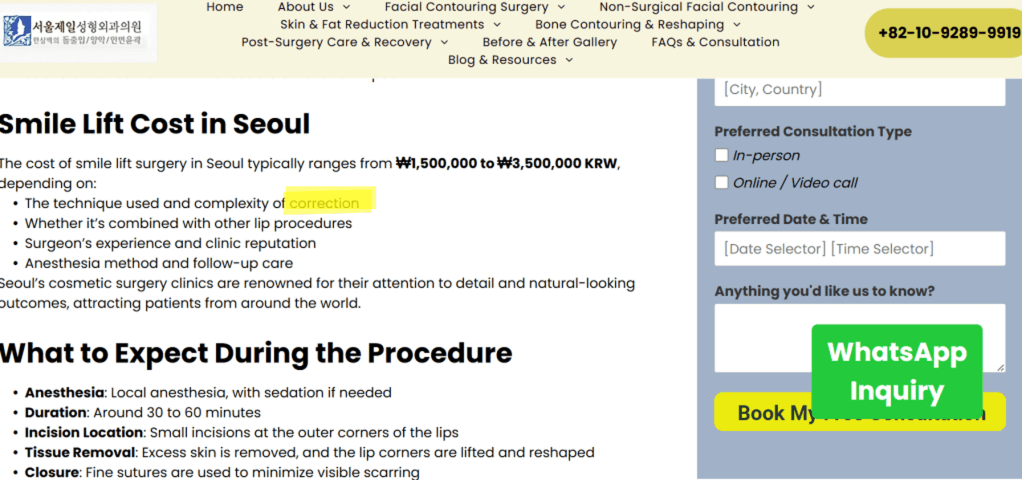
Source: https://www.facialcontouringkorea.com/smile-lift-surgery
Overall, the message is clear: as women, we owe the world our smile, our likeness, our compliance. As men, we owe authority, toughness, and emotional distance. This feeds the patriarchy, keeps us buying more and more ‘corrections’, and keeps power where it already is: in the hands of the few.
I’d Rather Be A Modern Bitch, Thanks
I say women don’t owe you their smiles, their softness, or their emotional labour. I say men don’t owe you their dominance, invulnerability, or silence. Meeting these expectations is utterly exhausting. I’d much rather have a ‘resting bitch face’ and put my energy into love, care and compassion for myself and others. I therefore reinstate my RBF as a feminist act that declares to the world I refuse to participate in the rigged game that is gender norms. I hope you can join me – because, when neutrality (or RBF) is treated as hostility, when boundaries are framed as rudeness, and when faces are surgically altered to appear more agreeable, the problem is no longer personal – it’s systemic.
 A Systems Lens
Leave a comment