The Systems Change Process
Check out our introductory blogs to understand more about what systems change is!
A practical way to create lasting change – by going beyond symptoms to tackle root causes.
What is systems thinking?
Systems thinking is a way of understanding and addressing complex problems by looking at the whole system rather than isolating individual parts.
It recognises that issues are interconnected, and that changes in one area can have ripple effects elsewhere. Rather than focusing solely on symptoms, systems thinking encourages us to identify root causes, map relationships, and understand feedback loops – helping us find leverage points for meaningful, long-term change. It’s especially useful in tackling complex challenges like poverty, climate change, or public health, where social, political, economic, and environmental factors all interact.
Why This Matters
Many organisations are set up to solve the visible parts of a problem – what we can measure or easily understand. But most of today’s big challenges – whether in society, the environment, or within organisations – are systemic. That means they’re connected to deeper patterns, causes, and relationships.
To make a real difference, we need to look at the whole system and understand what’s really driving the problem. That’s where this process helps.
I guide organisations and cross-sector teams through a step-by-step journey to uncover root causes, make sense of complexity, and design practical solutions using systems thinking. This approach is grounded, collaborative, and works across many different sectors and types of challenges.
The Process
A simple but powerful 4-step process I guide organisations through:
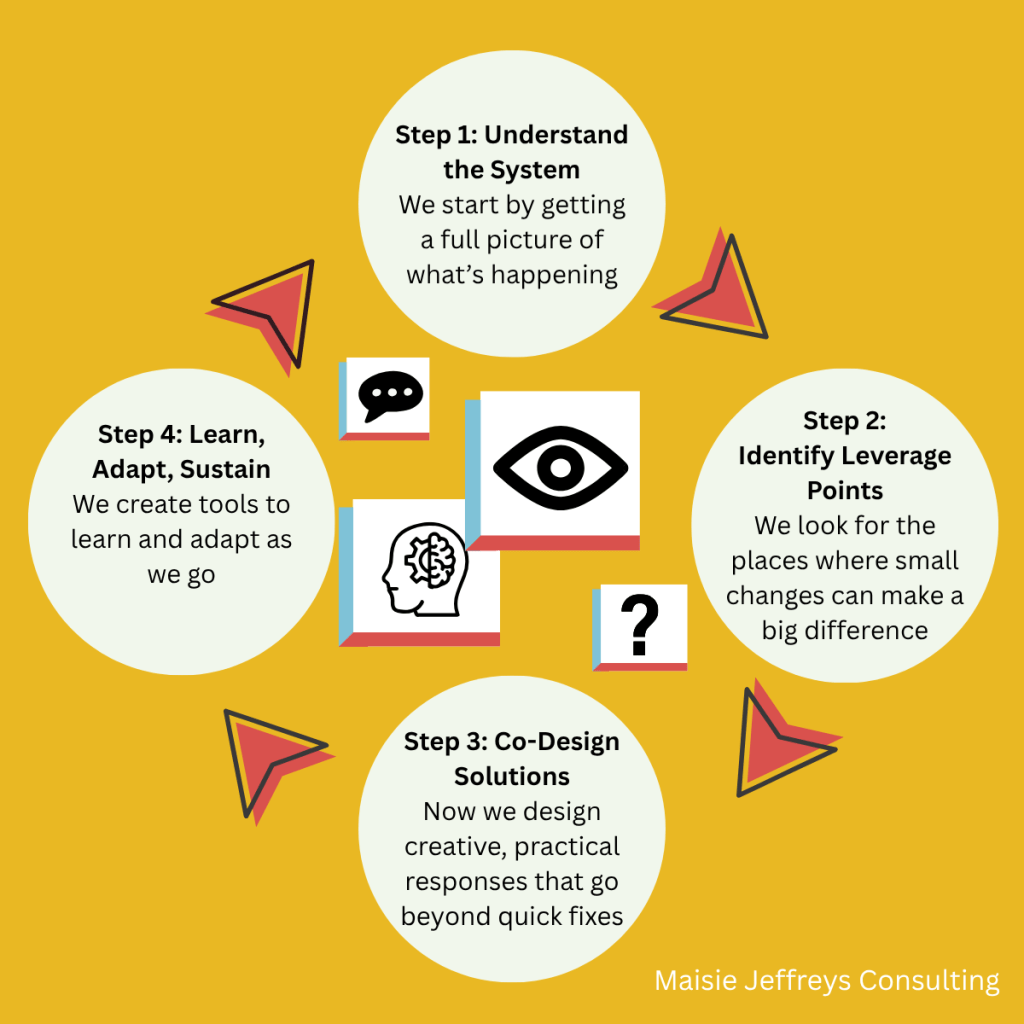
Step 1: Understand the System
“The behaviour of a system is a consequence of its structure.” — Donella Meadows
We start by getting a full picture of what’s happening:
- Who and what is involved? What is their unique experience? How can intersectionality help us to map this?
- How are things connected?
- What history or experiences are shaping the current situation?
- What are the root causes of challenges (visible and invisible)?
Step 2: Identify Leverage Points
We look for the places where small changes can make a big difference.
- Where are the key pressure points in the system?
- What can we shift – like habits, rules, or relationships – to create long-term change?
Step 3: Co-Design Solutions
Now we design creative, practical responses that go beyond quick fixes.
- How can we act at multiple levels – individual, organisational, and system-wide?
- What ideas are already working, and where can we try something new?
Step 4: Learn, Adapt, Sustain
Lasting change doesn’t happen all at once – it needs learning and flexibility. We create tools to learn and adapt.
- How will you test and improve as you go?
- How will you scale or evolve what’s working?
What Makes This Different
- Tackles the root causes of key challenges and systemic issues – not just the symptoms, having real lasting impact
- Builds your team’s skills, not reliance on outside help
- Embraces diverse knowledge, equity, and adaptability
- Works across many sectors – social impact, government, health, climate, education, innovation, and more
Who This Is For
This process is designed for:
- Organisations facing complex, recurring challenges
- Organisations seeking long-term, systemic impact
- Those aiming for collaboration, not fragmentation
- Teams wanting to build internal capacity in systems thinking
 A Systems Lens